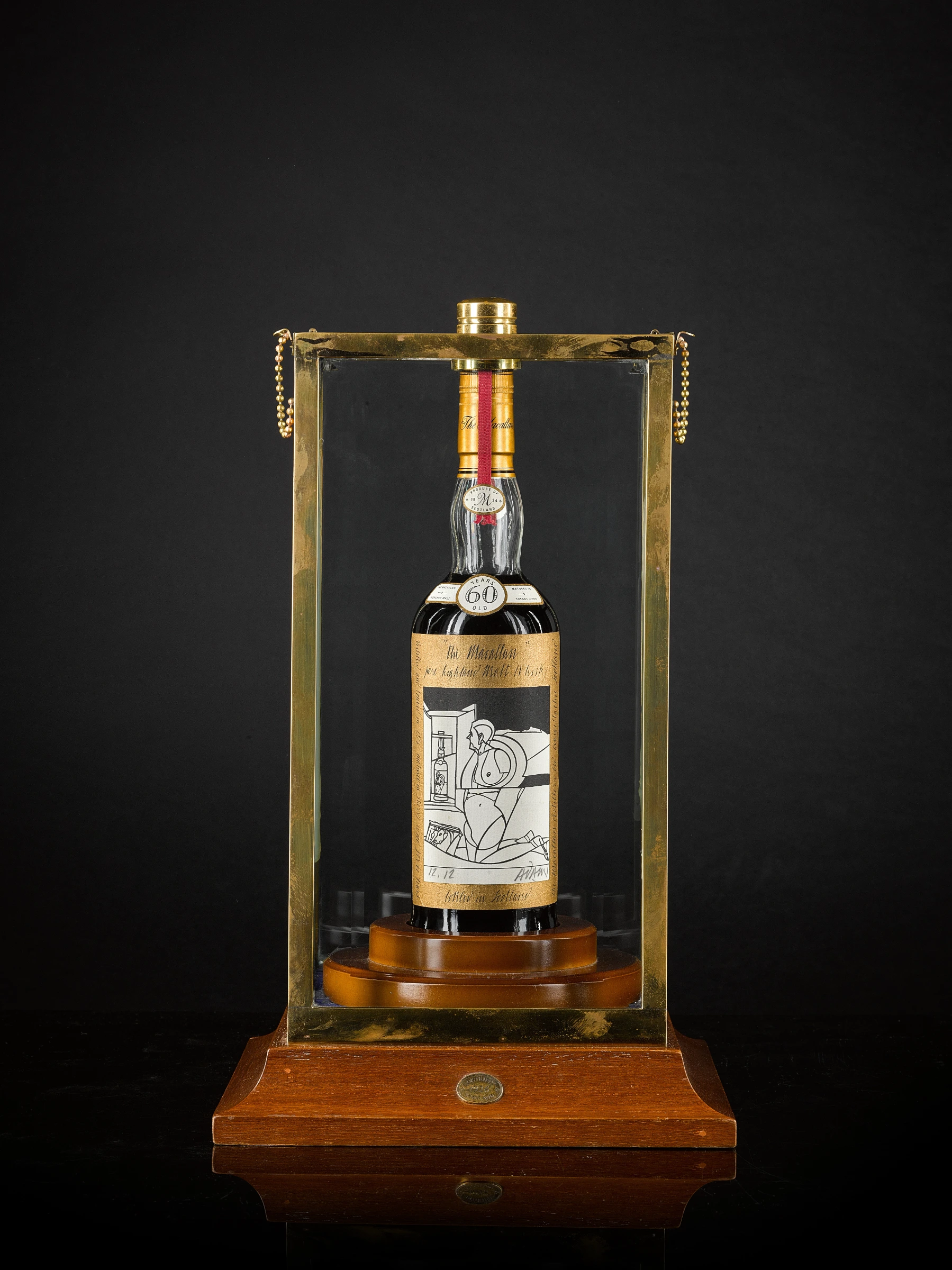
Someone has just paid £2.125 million for a bottle of whisky. The bottle in question is The Macallan Fine & Rare 60 Year Old 1926, sold on 9 October at Sotheby’s first auction held at The Macallan Estate in Speyside. It was distilled a century ago, matured for 60 years and bottled in 1986. Only 40 bottle equivalents emerged from the original cask. It is an extraordinary object.
But there is a problem. You are supposed to drink it. That simple fact creates one of the strangest contradictions in modern collecting. A painting can be viewed thousands of times without diminishing it. A vintage Ferrari can be driven carefully and remain a Ferrari. A Patek Philippe can be worn for decades, serviced and handed to another generation.
Whisky is different. The ultimate purpose of whisky is consumption. Open the bottle, pour 30ml into a glass and you have just permanently altered an object worth more than many exceptional houses.
Finish it and the collectible is gone. At some point, therefore, a rare whisky stops behaving like a drink and starts behaving like an asset. The Macallan 1926 may be the clearest example of where that transformation occurs.
One Cask, Forty Bottles
The story begins in 1926, when new-make spirit was placed into cask number 263 at The Macallan in Speyside. It stayed there for 60 years. When the whisky was finally bottled in 1986, the cask produced just 40 bottle equivalents. A maximum of 14 eventually carried The Macallan’s Fine & Rare label. Twelve received labels designed by British pop artist Sir Peter Blake, while another twelve were given labels by Italian artist Valerio Adami.
Two were initially left without labels. One was later hand-painted by Irish artist Michael Dillon. The liquid was essentially born together. What happened to the bottles afterwards transformed them into different objects.
That distinction is fascinating because it demonstrates how collecting works. The whisky matters enormously, but liquid alone cannot explain the extraordinary differences in desirability between individual bottles. The label matters. The artist matters.
The history matters. Condition matters. Provenance matters.
Which auction house sells it matters. And increasingly, the story surrounding the bottle matters almost as much as what is inside it. This is no longer simply connoisseurship.
It is collecting.
£2.125 Million for Something You Can Finish at Dinner
The latest Sotheby’s result makes the absurdity beautifully clear. The 700ml bottle sold for £2.125 million. At a conventional 25ml pour, that works out to roughly 28 measures. That means the purchase price represents almost £76,000 per glass before anyone has even considered whether ice is permitted.
Of course, this is a ridiculous way to calculate it. That is precisely the point. Nobody bidding more than £2 million was valuing the Macallan as 28 drinks.
The bottle has escaped the economics of consumption. The same thing happens elsewhere in collecting. A Ferrari 250 GTO is technically transportation, but nobody values it according to how efficiently it can take two people to lunch. A Basquiat is technically pigment on canvas. A rare Patek Philippe still tells the same time as a watch costing a tiny fraction of the price. At a certain level, function becomes almost irrelevant.
The object becomes a container for rarity, history, provenance, cultural importance and desire. The Macallan 1926 happens to contain whisky as well.
The Bottle Has Become More Important Than the Drink
This is where rare whisky becomes particularly interesting. The Macallan 1926 has tasting notes. There are descriptions of dried fruit, dates, treacle, old oak and spice. Before the 2023 Sotheby’s sale, The Macallan’s Master Whisky Maker Kirsteen Campbell was even able to nose that bottle after it had been reconditioned and authenticated. But very few people will ever know what a full glass tastes like.
That has not reduced the value. It has increased it. The less likely something is to be consumed, the more successfully it can become collectible.
There is an almost philosophical absurdity to that. A whisky achieves such extraordinary status that performing the act for which it was created begins to look irresponsible. The better the collectible becomes, the less likely anyone is to experience the liquid.
Whisky Is Starting to Behave Like Art
The connection to art is not accidental. The Macallan understood early that the bottle itself could become a cultural object. The involvement of Peter Blake, Valerio Adami and Michael Dillon did more than make attractive labels. It placed art directly into the mythology of the whisky. The Valerio Adami version demonstrated this spectacularly in 2023 when one of the twelve Adami-labelled bottles sold through Sotheby’s in London for £2,187,500.
The latest Fine & Rare bottle has now achieved £2.125 million at the estate where the whisky was originally created. Same vintage. Same extraordinary cask.
Different presentation. Different provenance. Different moment.
That is exactly how mature collecting categories behave. Collectors do not simply ask, “What is it?” They ask, “Which one is it?”
Rarity Is Not Enough
There are plenty of things in the world with only 40 examples that nobody particularly wants. Rarity alone does not create value. The object needs a mythology.
The Macallan has spent decades building one of the strongest in whisky. Its association with sherry-seasoned oak, old vintages, elaborate releases and increasingly ambitious presentation has made the distillery particularly legible to collectors. You do not need to be a whisky expert to understand what an old Macallan represents. That matters.
The strongest collectible brands tend to have a hierarchy outsiders can understand. Ferrari has the GTO and F40. Porsche has the Carrera RS. Rolex has the Daytona. Patek Philippe has its perpetual calendars and historically significant references. The Macallan has 1926. Once an object becomes the accepted pinnacle of a category, scarcity starts reinforcing itself. Owners become reluctant to sell. Auction appearances become events. Each significant result becomes another piece of provenance for the category itself.
The object acquires cultural gravity.
Time Is the One Ingredient Nobody Can Manufacture
There is another reason old whisky occupies such an unusual position. You cannot speed it up. A luxury company can make another handbag tomorrow. A watchmaker can manufacture another watch. Ferrari can announce another limited-run hypercar.
Nobody can decide today to produce another whisky distilled in 1926. That sounds obvious, but economically it is powerful. Time has permanently closed the supply.
Even more importantly, some of the conditions that created historic whiskies no longer exist in precisely the same form. Production methods change. Casks change. Regulations change. Companies change. People change. The liquid therefore becomes evidence of a moment that cannot be repeated. Collectors are not simply buying age.
They are buying irreversibility.
But Is It an Investment?
This is where the conversation needs discipline. Record auction prices make rare whisky look seductively simple as an investment category. Buy bottle. Wait. Sell bottle for more. Reality is considerably less convenient.
The £2.125 million Macallan is not representative of whisky as an asset class. It is an extreme object sitting at the very top of the collecting hierarchy. Condition can materially affect value. Authentication matters. Storage matters. Provenance matters. Transaction costs matter. Auction premiums matter. Fashion changes. Liquidity can disappear. And most importantly, a bottle does not produce cash flow while you own it.
The spectacular performance of a handful of Macallans should no more convince somebody that every expensive whisky is an investment than the price of a Ferrari 250 GTO should convince them that every old car will appreciate. Collecting and investing can overlap. They are not the same activity.
The most sensible collectors usually understand the difference.
There Is Also Something Slightly Sad About It
For all the fascination around record prices, there is something strange about the greatest whiskies becoming effectively undrinkable. Whisky is fundamentally social. A bottle exists to be opened. Someone pours it. Someone smells it. Somebody takes a sip and thinks it is extraordinary. Somebody else thinks the cheaper bottle was better.
Another glass gets poured. Stories become longer. The bottle becomes lighter.
Eventually it is empty. That is what whisky does. A £2 million valuation interrupts that cycle.
Suddenly the bottle must remain sealed because opening it would destroy too much financial value. The whisky survives, but its purpose does not. The collector preserves the object by refusing to complete the experience. There are museums full of objects we are not allowed to touch.
Rare whisky may be the only museum object we are not allowed to taste.
Would You Open It?
Imagine, for a moment, that someone gave you the bottle. Not to sell. Not to display.
Yours. Would you open it? The romantic answer is yes.
Whisky was made to be drunk. Gather five extraordinary friends, find the right room, turn off the phones and make a memory nobody could purchase afterwards. It sounds wonderful. Then somebody reminds you the bottle is worth more than £2 million.
Suddenly the cork becomes heavier. That hesitation is the entire story. Because the moment you cannot bring yourself to open the bottle, it has stopped being whisky in the ordinary sense.
It has become something else.
The SKR Perspective
Luxury is often described through excess: more craftsmanship, more rarity, more time, more money. The Macallan 1926 suggests that the very top of luxury eventually produces the opposite. You get less.
One cask. Forty bottles. A handful of surviving examples.
Almost no opportunity to taste them. And an increasingly small number of people willing to open one. That scarcity is precisely what makes the object valuable, but it also creates a contradiction. The closer a bottle gets to becoming the ultimate whisky collectible, the further it moves from being whisky anyone actually drinks.
Perhaps that is why the Macallan 1926 is such an extraordinary object. It sits exactly on the border between consumption and preservation. Between taste and ownership.
Between whisky and art. The person who paid £2.125 million yesterday did not simply buy an exceptionally old Scotch. They bought the responsibility of deciding what happens next.
Keep it sealed and preserve one of the most important objects in whisky collecting. Or remove the cork and do the one thing the bottle was made for. Drink it.
Snapshot
Whisky: The Macallan Fine & Rare 60 Year Old 1926 · Distilled: 1926 · Bottled: 1986 · Age: 60 years · Cask: No. 263 · Original Outturn: 40 bottle equivalents · Fine & Rare Examples: Maximum of 14 · Latest Auction: Sotheby’s, The Macallan Estate, 9 October 2026 · Latest Price: £2.125 million · 2023 Adami Result: £2,187,500 · Why It Matters: The Macallan 1926 has become the benchmark object at the top of whisky collecting, where provenance, rarity, art and history can matter as much as the liquid itself.
Verdict
There is a point at which an expensive bottle is still something you save for a special evening. Then there is a point at which opening it feels financially reckless. The Macallan 1926 crossed that line a long time ago.
At £2.125 million, the most interesting thing about the bottle is no longer how the whisky tastes. It is whether anyone will ever be brave enough to find out.
Short Sources
Sotheby’s — Live from The Macallan Estate, 9 October 2026 · Sotheby’s — The Macallan Fine & Rare 60 Year Old 1926 · Sotheby’s — The Macallan Valerio Adami 60 Year Old 1926 · The Macallan — A Legacy in the Making: The Macallan 1926 · The Macallan — Fine & Rare Collection · The key current figures are verified: the 2026 Fine & Rare sale was £2.125 million, while the Adami-labelled 1926 remains higher in sterling at £2,187,500 in 2023. The original cask produced 40 bottle equivalents after 60 years of maturation. · The Macallan and Sotheby’s Macallan 1926 auction lot provide the primary background and lot details.