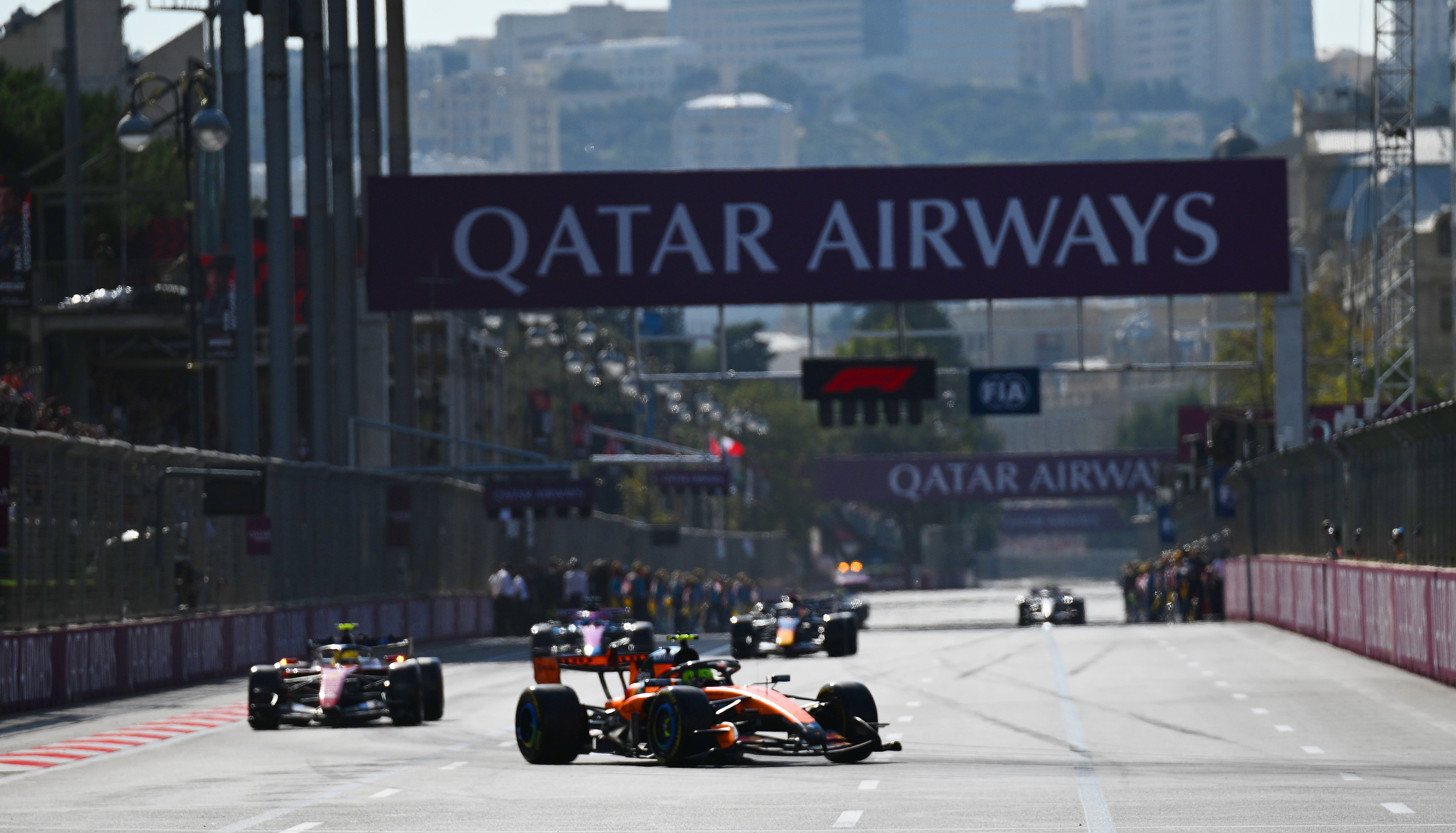
George Russell won the Azerbaijan Grand Prix by 0.196 seconds after a race of walls, Safety Cars, mistakes and genuine uncertainty. Two weeks after Madrid’s new street circuit struggled to produce overtaking, Baku offered Formula 1 a useful reminder: a city race should feel like the city is fighting back.
After 51 laps around Baku, George Russell and Max Verstappen were separated by less than two tenths of a second.
Russell crossed the line 0.196 seconds ahead of the Red Bull.
Behind them, Isack Hadjar completed the podium.
Six drivers failed to finish.
There were two Safety Car periods.
Lando Norris and Pierre Gasly were eliminated after Franco Colapinto locked up at a restart. Alex Albon hit the wall. Valtteri Bottas found the barriers late in the race.
Russell had controlled much of the afternoon.
Then Baku interfered.
That is rather the point.
Formula 1 has become increasingly interested in cities.
Miami.
Las Vegas.
Madrid.
Jeddah.
Singapore.
Baku.
Monaco.
There are obvious commercial reasons.
A city provides hotels, restaurants, corporate hospitality, nightlife, airports, wealthy visitors and images far more marketable than another grandstand beside a field.
But putting barriers around a piece of urban asphalt does not automatically create a great street circuit.
Baku works because the city is not merely scenery.
It interferes with the racing.
The circuit compresses modern Formula 1 cars through the medieval Old City before releasing them onto a 2.2-kilometre flat-out stretch — the longest straight on the current calendar.
At its narrowest point around Turns 8 and 9, the circuit is only 7.6 metres wide.
That contradiction is the circuit.
Claustrophobia followed by enormous speed.
Precision followed by commitment.
Walls followed by air.
Two weeks before Baku, Formula 1 raced at the new Madring for the first time.
The circuit did some things well.
Drivers and teams praised the facilities and the challenge of driving it. Qualifying provided tension.
The race itself exposed the problem.
Overtaking was scarce.
The intended opportunity at the Turn 5 chicane did not work as hoped, and organisers have already said they are prepared to alter the circuit for 2027 after receiving recommendations from the FIA.
That is an extraordinary contrast.
Formula 1 has spent enormous energy building a new urban spectacle in Madrid.
Baku simply reminded everyone that spectacle and racing are not the same thing.
This is where the argument becomes more interesting.
Baku should not be romanticised.
Even Formula 1’s own technical preview noted that overtaking there has historically been difficult and that the circuit can be heavily biased towards qualifying position.
So why does Baku so often feel alive?
Because overtaking statistics are not the only measure of a circuit.
Risk matters.
Braking matters.
Strategy matters.
Visibility matters.
Track evolution matters.
The possibility of a mistake matters.
And walls matter.
A circuit can manufacture passing opportunities and still produce forgettable racing.
Another can make passing difficult while creating enormous tension around every attempt.
Baku understands the second idea.
Modern Formula 1 circuits are extraordinarily safe compared with previous eras.
They should be.
Nobody needs motorsport to become more dangerous in order to become more entertaining.
But safety and consequence are not opposites.
A driver can run wide at some modern circuits and lose very little.
At Baku, getting greedy with an apex can end the afternoon.
The castle section is narrow enough to make a Formula 1 car look absurdly large.
Turn 15 arrives partially unsighted.
The first sector asks drivers to brake from enormous speeds.
And because the circuit uses public roads until shortly before the race weekend, grip evolves dramatically as the surface cleans and rubber builds.
None of those characteristics requires unnecessary danger.
They simply require precision.
That is what a street circuit should demand.
The most convincing street circuits feel as though Formula 1 has temporarily invaded somewhere it does not entirely belong.
That tension creates character.
Monaco is absurdly narrow because Monaco is absurdly narrow.
Singapore races beneath lights through a dense modern city.
Baku threads cars past ancient walls before firing them down a straight where aerodynamic efficiency suddenly becomes everything.
The location creates the circuit.
The danger with the new generation of urban Grands Prix is reversing that relationship.
First design the commercial event.
Then find enough asphalt to put a racetrack through it.
The result may be technically a street circuit while possessing little of the unpredictability that made street racing interesting in the first place.
This is not an argument that every street race should copy Baku.
Quite the opposite.
Formula 1 needs circuits with distinct identities.
Monza should feel nothing like Monaco.
Suzuka should feel nothing like Silverstone.
Baku should feel nothing like Singapore.
And Madrid should eventually feel like Madrid.
Homogenisation is the enemy.
If every circuit is engineered around the same overtaking formula, the championship loses one of its greatest strengths: forcing the same cars and drivers to solve radically different problems.
Baku asks an unusual question.
How little downforce can you carry down that enormous straight without making the car intolerable through the technical sections?
That compromise produces personality.
Formula 1’s new-generation cars have changed the overtaking equation.
Straight Mode allows the front and rear wings to reduce drag on designated sections, while Overtake Mode gives a pursuing driver additional electrical deployment when the required conditions are met.
Baku has two Straight Mode zones and an Overtake Mode activation section leading towards its enormous final run.
That means circuit design matters differently now.
The sport can alter aerodynamic behaviour.
It can alter energy deployment.
It can give drivers tools to attack.
But software cannot rescue fundamentally poor geometry.
The track still matters.
Russell led from the start and controlled the opening phase.
On another circuit, that might have been the story.
Pole-to-flag.
Twenty-five points.
Next race.
Instead, Albon’s accident brought out the Safety Car.
Then came another interruption after Colapinto’s lock-up eliminated Norris and Gasly.
The field compressed.
Verstappen arrived.
And after 51 laps, Russell’s margin was 0.196 seconds.
The result was not created by an artificial late-race gimmick.
It emerged because the circuit kept asking questions.
Eventually, somebody answered one incorrectly.
Formula 1 does not need more chaos for the sake of chaos.
It needs circuits with consequences.
There is a difference.
Baku is imperfect.
Overtaking can still be difficult. Safety Cars can distort a race. A crash can turn strategy into lottery.
But the circuit possesses something increasingly valuable in a global championship becoming ever more polished: character.
You recognise Baku before seeing the circuit name.
The medieval walls.
The impossible-looking castle section.
The enormous straight.
The Caspian skyline.
The braking zones.
The barriers waiting immediately beyond the mistake.
Madrid has the money.
Miami has the hospitality.
Las Vegas has the spectacle.
Those things matter. Formula 1 is an entertainment business as much as a sporting championship.
But the asphalt eventually has to justify the weekend.
A city Grand Prix should not merely provide somewhere attractive to put the paddock.
The city should change the race.
Baku does.
That is why, two weeks after Formula 1 discovered that a brand-new street circuit can still struggle to create racing, Azerbaijan provided the more useful lesson.
A great street circuit should feel slightly inconvenient for a Formula 1 car.
That inconvenience is where the character lives.
Race: 2026 Azerbaijan Grand Prix Winner: George Russell — Mercedes Second: Max Verstappen — Red Bull Racing Winning Margin: 0.196 seconds Third: Isack Hadjar — Red Bull Racing Race Distance: 51 laps / 306.042 km Safety Cars: Two Baku Main Straight: Approximately 2.2 km — longest on the current F1 calendar Narrowest Section: Approximately 7.6 metres at Turns 8/9 2026 Technology: Straight Mode and Overtake Mode both play significant roles in Baku’s racing equation.
Madrid showed that putting Formula 1 inside a city does not automatically create a great street race.
Baku showed what happens when the city actually shapes the circuit.
Don’t build a racetrack and surround it with a destination.
Let the destination build the racetrack.
[FIA — 2026 Azerbaijan Grand Prix](https://www.formula1.com/en/latest/article/russell-narrowly-holds-off-verstappen-to-take-victory-over-the-line-in-chaotic-azerbaijan-gp.5J4lgNh82JDL2GM302irF0) [Formula 1 — Baku Circuit Guide](https://www.formula1.com/en/latest/article/circuit-guide-everything-you-need-to-know-about-the-baku-city-circuit.320UGBNQu2ALdgAtax1gRn) [Formula 1 — Baku Risk & Strategy Analysis](https://www.formula1.com/en/latest/article/the-risk-perspective-how-f1-drivers-engineers-and-strategists-tackle-the-baku-city-circuit.6EfE3Te9Jy250uKPQ5veSp) [Autosport — Madring Changes Following F1 Criticism](https://www.autosport.com/f1/news/spanish-gp-organisers-promise-madring-track-changes-following-f1-criticism/10855769/) Reuters — Azerbaijan Grand Prix