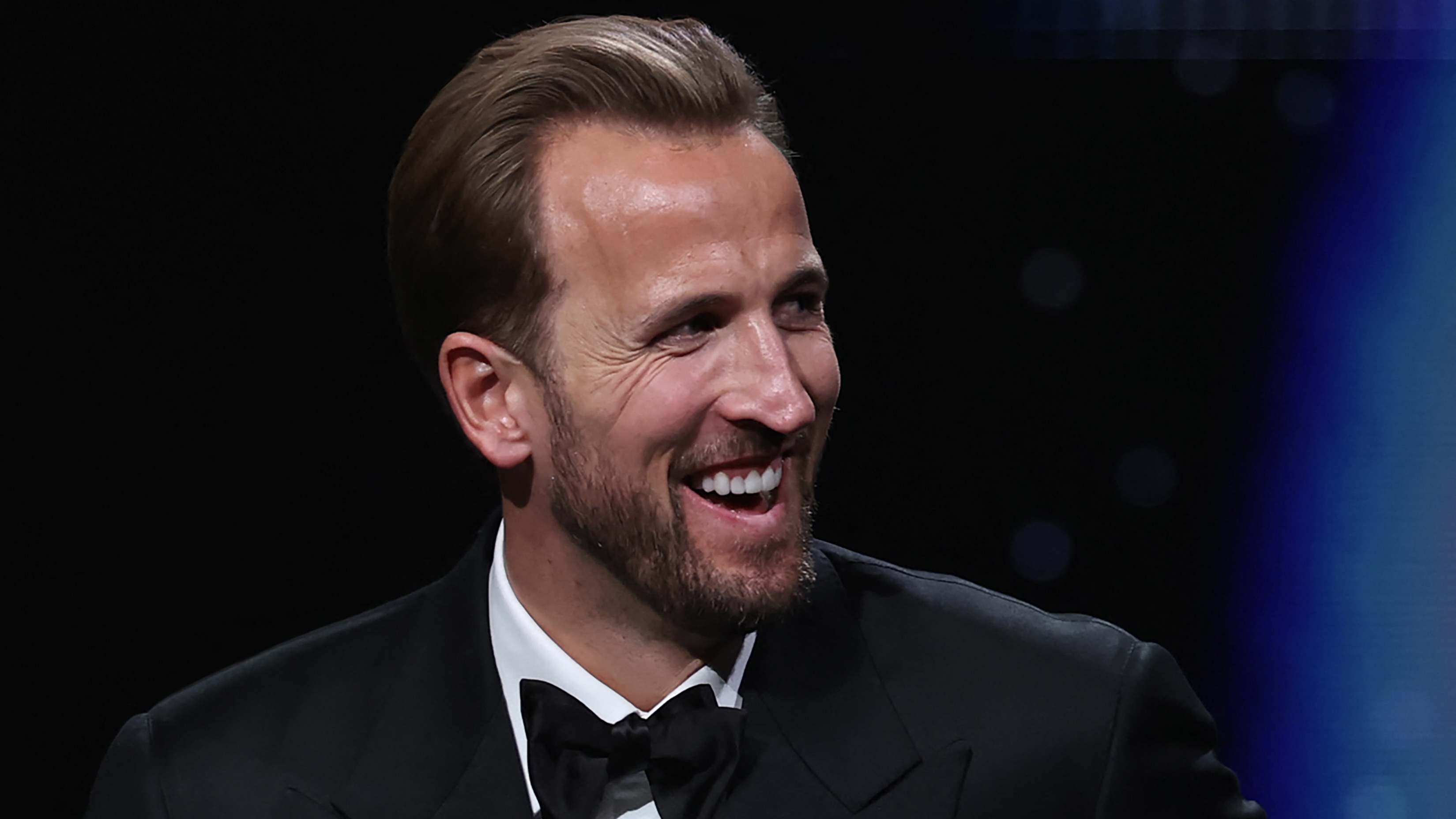
Harry Kane spent most of his career being told what he had not won.
It became the easiest criticism in football.
Never mind the goals.
Never mind the records.
Never mind that he became Tottenham Hotspur’s all-time leading scorer, England’s record goalscorer and one of the defining centre-forwards of his generation.
Where were the trophies?
On Monday night in London, the question finally became obsolete.
Harry Kane is the 2026 Ballon d’Or winner.
At 33, the Bayern Munich striker finished ahead of Kylian Mbappé and Lamine Yamal to become the first Englishman to win football’s most famous individual prize in 25 years.
Michael Owen was the last, in 2001.
For Kane, however, the significance goes beyond becoming another name engraved on a trophy.
This is the moment that changes how an entire career will be remembered.
73 Goals Made the Argument Difficult
Ballon d’Or debates are usually complicated.
Kane made this one considerably simpler.
He scored 73 goals for club and country across all competitions during the 2025/26 campaign.
Sixty-one of those came in 51 competitive appearances for Bayern.
He scored 36 times in the Bundesliga, winning the European Golden Shoe for the second time.
He finished as the Bundesliga’s leading scorer for a third consecutive season.
He added 14 goals in the Champions League as Bayern reached the semi-finals.
And he scored six times for England at the 2026 World Cup.
These are not simply excellent numbers.
They are the kind that make you check whether you have read them correctly.
But goals have never really been the problem with Harry Kane.
The problem was everything people insisted needed to sit beside them.
The Trophy Question Followed Him Everywhere
Kane left Tottenham in 2023 with 280 goals for the club.
He had become Spurs’ record scorer.
He had scored 213 Premier League goals.
He had captained England.
He had won a World Cup Golden Boot.
He had reached a Champions League final with Tottenham and European Championship finals with England.
Still, one fact followed him around.
No major team trophy.
Football can be strangely unforgiving about this.
A striker can spend a decade doing his job at an extraordinary level and still have his individual quality reduced to what eleven players collectively failed to win.
Kane became perhaps the clearest example of it.
Every record came with an asterisk somebody else wanted to attach.
Every great season eventually returned to the same question.
But did he win?
When Kane moved to Bayern Munich at 30, the question became almost cruel.
He had joined one of the most successful clubs in Europe, partly to compete consistently for the trophies missing from his career.
Then Bayern failed to win the Bundesliga in his first season.
The joke practically wrote itself.
Except Kane kept scoring.
And then the trophies arrived.
Bayern Changed the Ending
There is a temptation to describe Kane’s move to Munich as a reinvention.
It wasn’t.
He did not suddenly become an elite striker in Germany.
He already was one.
What Bayern gave him was a different context for the same excellence.
By 2025/26, Kane had his answer.
Bayern won the Bundesliga and DFB Cup, while Kane produced what he called the best season of his career.
His 36 league goals delivered another Golden Shoe.
His hat-trick in the DFB Cup final provided the kind of cinematic trophy-winning performance that his critics had spent years demanding.
Then came the Ballon d’Or.
It is remarkable how quickly the vocabulary around a player can change.
For years, Kane was the great striker who had never won.
Now he is a multiple Bundesliga champion, a German Cup winner, a two-time European Golden Shoe recipient and the best player in the world according to the Ballon d’Or vote.
Same footballer.
Different résumé.
London Was the Right Place
There was something unusually neat about where it happened.
The 2026 Ballon d’Or marked the award’s 70th anniversary and was held in London for the first time.
The location paid tribute to Sir Stanley Matthews, the Englishman who won the inaugural Ballon d’Or in 1956.
Seventy years later, another England captain collected it in the city where his own football story began.
Kane grew up in London.
He spent almost two decades associated with Tottenham.
He became England captain.
Then he had to leave England to finally acquire the silverware that English football had used to measure him.
He returned home as the best player in the world.
He Did Not Need to Become More Spectacular
Kane’s Ballon d’Or is also interesting because of the kind of footballer he is.
There is very little mythology in the way he plays.
He is not built around stepovers.
He does not require a highlight reel to explain his value.
He does not appear to be performing a character between matches.
Kane’s football has always been unusually functional.
Find space.
Receive.
Turn.
Pass.
Arrive.
Finish.
Repeat.
That apparent simplicity can disguise how complete his game became.
The younger Kane was primarily discussed as a goalscorer.
The mature version can drop into midfield, manipulate defenders, release runners and still arrive in the penalty area quickly enough to finish the move.
At Bayern, the goals did not disappear as the rest of his game expanded.
They multiplied.
There Is Something Unfashionable About Longevity
Modern football is obsessed with the next thing.
The next teenager.
The next €100 million player.
The next viral performance.
The next person who might dominate football for ten years.
Kane won his first Ballon d’Or at 33.
That matters.
Not because 33 is particularly old anymore, but because Kane’s career has been built through accumulation rather than sudden arrival.
There was no single season when football discovered Harry Kane.
He just kept scoring.
Season after season.
Manager after manager.
Competition after competition.
Country and club.
England and Germany.
Eventually the weight of the evidence became impossible to ignore.
The SKR Perspective
Football has a habit of rewriting careers backwards.
Win at the end and everything that came before starts looking like destiny.
Lose and the same journey becomes evidence of some supposed deficiency.
Harry Kane exposes how ridiculous that can be.
He was not a worse footballer when Tottenham failed to win the Champions League final in 2019.
He was not suddenly more talented the morning after Bayern won the Bundesliga.
And the Ballon d’Or did not transform him into one of the finest strikers of his generation.
He already was.
What changed is that the final objection disappeared.
That is why this award feels larger than an exceptional 2025/26 season.
Kane spent years accumulating goals while football accumulated reasons not to place him alongside its most decorated greats.
No league title.
No major cup.
No Ballon d’Or.
One by one, those qualifications have fallen away.
And perhaps that is the most satisfying part of his story.
Harry Kane did not silence the trophy argument by talking about legacy.
He simply played long enough, and well enough, for the argument to run out of evidence.
At 33, the man who spent much of his career being asked what he had won finally has the trophy that changes the question.
Now we ask where he belongs among the greats.
Career Snapshot
Player: Harry Kane Age: 33 Club: Bayern Munich Award: 2026 Men’s Ballon d’Or Ballon d’Or finish: 1st Runner-up: Kylian Mbappé Third: Lamine Yamal 2025/26 goals: 73 for club and country Bayern goals: 61 in 51 competitive appearances Bundesliga goals: 36 Champions League goals: 14 World Cup goals: 6 2026 European Golden Shoe: Winner 2026 Ballon d’Or Striker of the Year: Winner England record: All-time leading goalscorer Tottenham record: 280 goals, club all-time leading scorer
Verdict
For years, Harry Kane’s career was discussed through absence.
The goals were there. The records were there. The performances were there.
The trophies weren’t.
Now the biggest individual one is sitting beside his name.
The Ballon d’Or does not make Harry Kane great.
It makes it considerably harder to pretend he wasn’t already.
Short Sources
UEFA — Harry Kane wins 2026 Men’s Ballon d’Or, 26 October 2026.
UEFA — Alexia Putellas and Harry Kane win 2026 Ballon d’Or awards, 27 October 2026.
FC Bayern Munich — FC Bayern placings at Ballon d’Or 2026, 27 October 2026.
FC Bayern Munich — Europe’s best goalscorer: Harry Kane wins Golden Shoe, May 2026.
FC Bayern Munich — Harry Kane player profile and career record.