Baltimore Was the Real Test
More than a century after South Africa and New Zealand first met in Test rugby, one of the sport’s oldest rivalries arrived somewhere rather less traditional.
Baltimore.
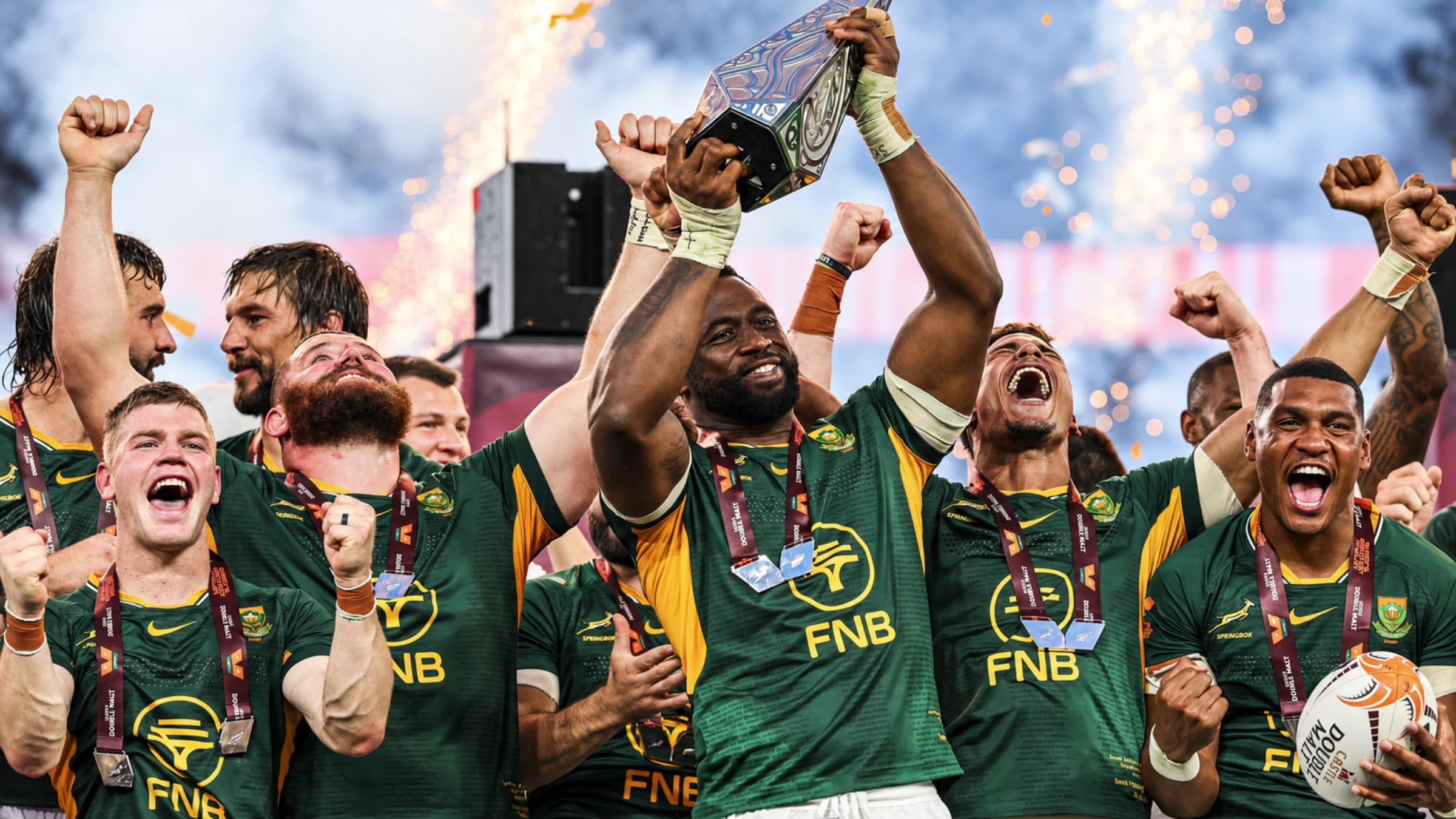
The Springboks won 43-28, completing a 3-1 series victory over the All Blacks after losing the opening Test.
That alone would have made the tour memorable.
But the result may not be the most important thing to emerge from Rugby’s Greatest Rivalry.
The experiment appears to have worked.
This was the first full-scale All Blacks tour of South Africa in 30 years, combining four Tests with matches against South African franchises before ending in the United States.
And importantly, organisers have already built the concept around something modern sport increasingly struggles to protect:
scarcity.
The return visit is expected in four years.
That feels about right.
Rugby Went Backwards to Move Forward
Modern sport usually responds to commercial pressure by adding things.
More competitions.
More teams.
More content.
More fixtures.
More sponsorship inventory.
This series did something almost unfashionably old-fashioned.
It let two national teams spend weeks trying to beat each other.
That matters.
A single Test gives you a result.
A series gives you a story.
One match affects the next.
Tactics evolve.
Players are injured.
Coaches adjust.
Supporters spend the week arguing about what went wrong.
Resentments accumulate.
By the fourth Test, everyone remembers the first.
That continuity creates something sport desperately needs in an era of fragmented attention:
narrative.
History Is an Asset
South Africa and New Zealand possess something no marketing agency can manufacture quickly.
Memory.
The rivalry stretches back to 1921 and more than 100 Tests.
Generations of players have inherited it.
Generations of supporters have inherited it too.
That matters commercially because the most valuable sporting properties are rarely valuable because of the physical game alone.
They are valuable because people care what happens.
A new franchise can buy players.
It can buy branding.
It can buy television production.
It can buy hospitality suites.
It cannot immediately buy somebody remembering watching the same fixture with a parent 20 years earlier.
The Springboks and All Blacks already own that.
America Changes the Question
Taking the final Test to Baltimore made this more than a nostalgic tour.
The United States will host the men’s Rugby World Cup in 2031.
That creates an obvious problem for rugby.
America does not lack entertainment.
It has too much of it.
The NFL, NBA, MLB, NHL, college sport, motorsport, combat sport and an enormous entertainment industry all compete for attention.
Rugby cannot enter that environment and simply ask people to appreciate tradition.
It needs events.
It needs personalities.
It needs recognisable stakes.
And it needs rivalry.
South Africa versus New Zealand already contains all four.
Baltimore therefore became an interesting proof of concept.
Not proof that America suddenly loves rugby.
That would be ridiculous.
But proof that elite rugby can travel when the proposition is strong enough.
The Trophy Told You What They Were Building
Even the trophy was designed differently.
Rather than a conventional cup, Rugby’s Greatest Rivalry created a trophy consisting of two halves drawn together magnetically.
Had the series ended level, each nation would have kept one half.
The winner took both.
It is clever because it gives the series an identity beyond another fixture on an increasingly crowded rugby calendar.
Branding can become painfully forced in sport.
This one works because the object reflects the rivalry.
Two countries.
Distinct.
Competitive.
But historically inseparable.
The Risk Is Overexposure
There is an obvious danger.
Once administrators discover that something works, they tend to schedule it until it stops working.
This cannot become another annual property simply because the first revival succeeded.
Part of the attraction is that it feels unusual.
Four Tests against the same opponent should feel excessive by modern scheduling standards.
Instead, it felt meaningful because it happened after such a long absence.
That is the trick.
The smartest thing rugby can do is resist the urge to maximise short-term inventory.
Play it rarely.
Make the result matter.
Take one game somewhere strategically interesting.
Then disappear long enough for people to want it again.
The SKR Perspective
Professional sport spends extraordinary amounts of money trying to manufacture what the Springboks and All Blacks already possess.
Meaning.
That may be the biggest lesson from this series.
South Africa won.
That matters.
But the commercial opportunity lies in what happened between the matches.
The debate after the opening loss.
The response in Cape Town.
The tension in Johannesburg.
The unfinished business that travelled to America.
That is why a series feels different from a fixture.
Sport is storytelling that nobody can completely script.
And South Africa versus New Zealand already has more than a century of plot.
The temptation now will be to commercialise every part of it.
More merchandise.
More destinations.
More hospitality.
More sponsors.
Some of that is inevitable.
Some of it will improve the product.
But scarcity is part of the value.
In an era when almost every piece of entertainment is available constantly, anticipation itself has become premium.
Rugby’s oldest rivalry may just have rediscovered a modern business model.
The clever part will be knowing when not to use it.
Series Snapshot
Series: Rugby’s Greatest Rivalry 2026
Result: South Africa 3-1 New Zealand
Final Test: South Africa 43-28 New Zealand
Final Venue: Baltimore, United States
Format: Four Tests plus South African franchise matches
Historical Context: First full-scale All Blacks tour of South Africa in 30 years
Next Edition: Reciprocal tour expected in four years
Verdict
The Springboks won the rugby.
Rugby may have discovered something larger.
Sometimes the oldest assets in sport still contain the most unexplored value.
Short Sources
Reuters All Blacks / New Zealand Rugby Image: @Springboks / X